


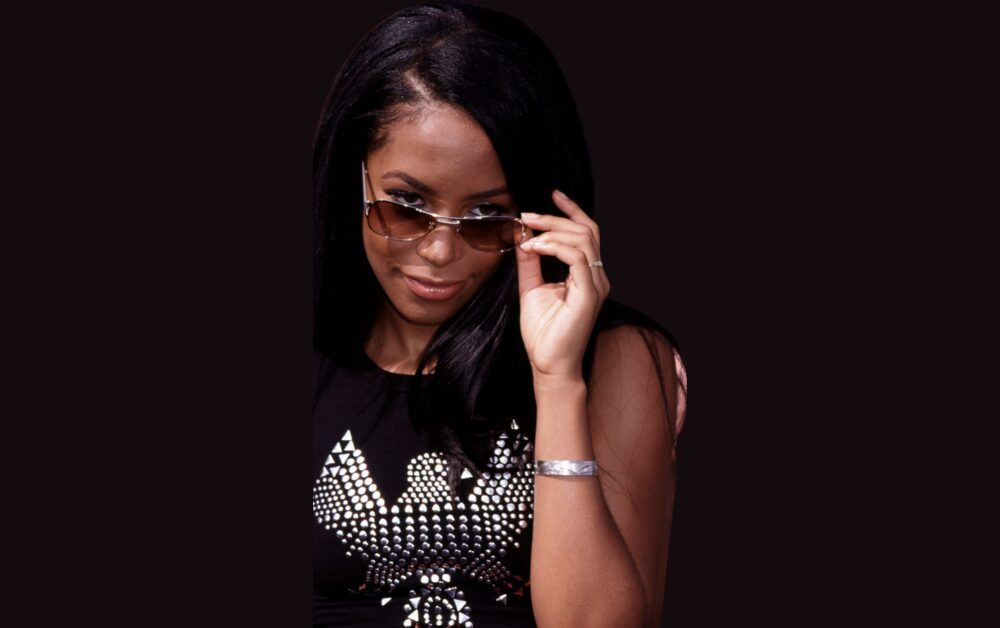
How Aaliyah and Timbaland Bent Time, and Made It Sexy
Aaliyah’s Beats Arrived Fashionably Late
In 1996, Aaliyah’s One in a Million didn’t just move R&B forward; it slanted the entire rhythm. Instead of gliding along polished grooves, her music limped, dragged, and jittered into an alien elegance. Timbaland was scrambling his beats’ time signatures and gridding drum machines like a mad scientist spiking the punch at prom. What they created together wasn’t just futuristic; it was a funhouse, distorted, hypnotic, and impossible to ignore.
This wasn’t New Jack Swing. It was something broken, and better for it. For more context, explore this list of the best ’90s R&B songs that shaped the decade.
Before We Wobbled: The Reign of the Grid
Before Timbaland, R&B grooves moved with geometric regularity. Picture Janet Jackson’s Control or Boyz II Men’s ballads: 16th-note hi-hats, snares on the 2 and 4, not a kick out of place. But on Aaliyah’s “One in a Million,” the drums wobble. Hi-hats don’t tick, they stutter. Kicks hide in unexpected corners of the bar. It feels like the beat’s had a few drinks but still lands every step.
————————————————————————————————————————————————————
————————————————————————————————————————————————————
Technically, it’s swing quantization, a method of shifting every other note just late enough to sound human. In Timbaland’s case, about 58 to 62 percent swing, a number producers now whisper like gospel. But more than the numbers, it’s the feel, a beat delayed into seduction.
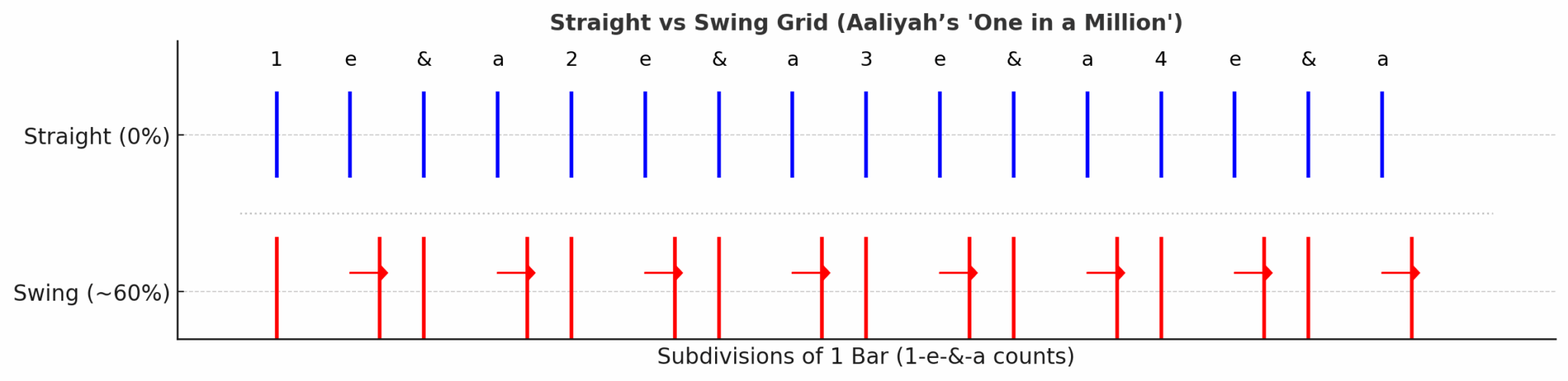
Aaliyah’s “One in Million” swing graph by Talmage Garn
————————————————————————————————————————————————————
Timbaland: Deleting Is Producing
The genius of Timbo’s approach isn’t just what he added but what he removed. Negative space becomes groove. Instead of filling the bars with percussion, he left voids, holes, and gulfs of silence. It’s anti-maximalism. That vacuum gave Aaliyah room to breathe, glide, and coo in whispered defiance.
Where others stuffed their tracks with gloss, he carved his into minimalist sculptures. It wasn’t sparse, it was surgical.
The Sexy Science of Stagger
Timbaland’s swing was about symmetry through asymmetry, a loop that sounded mechanical but moved like flesh. You could dance to it, but not in a straight line. And it cracked open R&B production for the next decade.
Ginuwine’s “Pony” gurgled with liquid bass and click-track voodoo. Missy Elliott built a whole iconography around it. Pharrell and The Neptunes pulled it inward, made it sleeker. And Drake’s producer, 40, used the same negative space to create moody music for icy Toronto bedrooms.
Aaliyah was the conduit for this rhymic revolution. Her delivery was so restrained, so breathy, that it made the beats sound even weirder. Like she was singing inside the beat, not over it, you can revisit her influence in this Aaliyah-focused archive.
Timbaland vs. J Dilla: The Two Hands of God
The other side of the broken rhythm revolution was happening in Detroit, where J Dilla was refusing the grid entirely. If Timbaland’s beats swung with mechanical precision, Dilla’s melted into molasses.
Timbaland nudged the grid. Dilla destroyed it.
Timbaland’s swing is quantized. Dilla’s is hand-played. His MPC3000 pulses late on some bars, early on others. The hi-hat races while the snare sighs. It’s not that he couldn’t program straight; it’s that he chose to sound human. Unpredictable. Emotional.
Dilla’s method let the rhythm breathe. It’s not swung, it’s alive. Compare Aaliyah’s “One in a Million” to Slum Village’s “Fall in Love.” Both are head-nod classics. But one floats like clockwork—the other slinks like smoke.
————————————————————————————————————————————————————
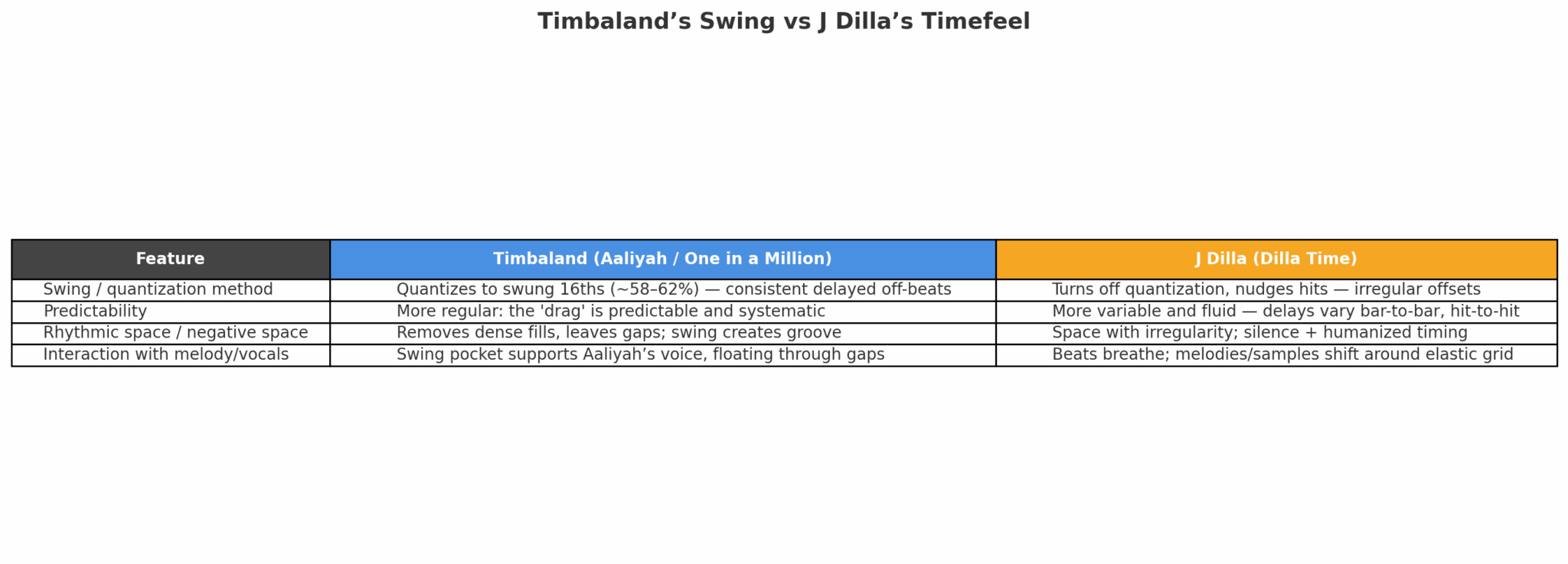
Timbaland, compared to J Dilla’s time feel – chart by Talmage Garn
————————————————————————————————————————————————————
Together, they formed a rejection of perfection. One formalized a new order. The other dissolved it completely. To dive deeper, check out this analysis of J Dilla’s offbeat legacy, or explore more on J Dilla here.
From Aaliyah to Eilish: The Vibe Lineage
The aftermath? R&B, hip-hop, and neo-soul all bent at the knee.
Erykah Badu, D’Angelo, and The Roots borrowed Dilla’s elastic time. Missy, Justin Timberlake, and even Beyoncé explored Timbo’s lurching swing. Twenty years later, Billie Eilish croons over skeletal beats, and trap producers still echo the sparse snare funk that Aaliyah made iconic.
Even now, those late hats and unexpected silences feel contemporary. Because they were never about trends, they were about trust. Trusting that people would lean in when the beat pulled away. More examples can be found in this guide to the best 2000s R&B songs.
Suggested Time-Feel Playlist:
- Aaliyah – “One in a Million” (Timbaland swing at its peak)
- Ginuwine – “Pony” (the sexiest robot hiccup ever recorded)
- Missy Elliott – “The Rain (Supa Dupa Fly)” (alien funk)
- Slum Village – “Fall in Love” (Dilla’s loopy drift) – further explored in this J Dilla time review and his top 18 iconic beats
- Erykah Badu – “Didn’t Cha Know” (Dilla meets astral projection)
The Grid Got Hacked—By a Whisper
Timbaland didn’t just bring swing to R&B; he disrupted the grid and made it groove. Aaliyah turned that instability into serenity. And together, they whispered a new rhythm into the future.
Not broken. Just bent enough to matter.