


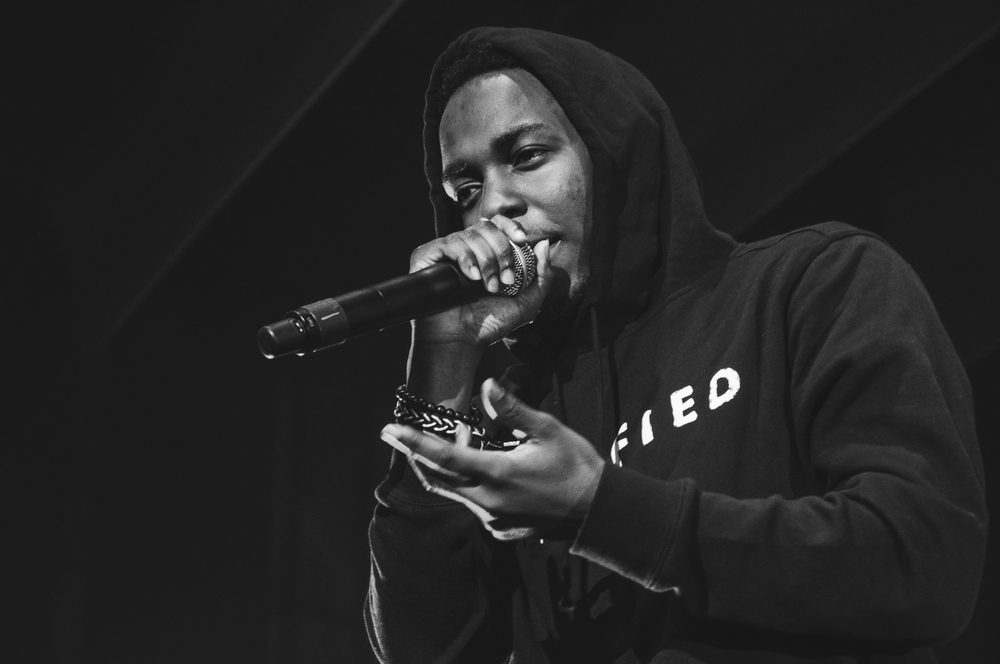
Kendrick’s good kid, m.A.A.d city | Film You Can’t Stop Rewatching
good kid, m.A.A.d city’s visual storytelling begins before the first beat.
The standard cover shows a childhood Polaroid of Kendrick Lamar seated with older relatives, his uncles and grandfather. On the table: a baby bottle, a 40-ounce, and a subtle hand sign. Everyone’s eyes are blacked out, except Kendrick’s. The image, Lamar explained, reflects the innocence of youth trying to interpret a chaotic environment. It’s a visual metaphor for the perspective the album inhabits: a child’s clarity in a distorted world.

The tagline, “a short film by Kendrick Lamar”, reinforces this cinematic framing. The deluxe edition deepens it further, swapping the family photo for an image of Kendrick’s mother’s burgundy van, the recurring vehicle that drives the album’s events. That van becomes a central prop, the setting for freestyles, peer pressure, robberies, and long rides through Compton. It links scenes like a camera dolly in a movie. The classic album came out on October 22, 2012.
The Story Arc: Scene by Scene in m.A.A.d Memory
The album doesn’t unfold in strict chronological order. Instead, it mirrors memory, messy, recursive, stitched together by recurring skits, voicemails, and motifs. Over 12 tracks, good kid, m.A.A.d city follows Kendrick’s teenage alter ego “K Dot” on a pivotal day in Compton. Through cycles of tension and reflection, we watch K Dot become Kendrick Lamar.
“Sherane a.k.a Master Splinter’s Daughter”
The album opens mid-memoir. Kendrick sets the scene with a hazy prologue about Sherane, a girl he’s drawn to despite danger signs. The song feels like a suspenseful Tarantino cold open. It’s not the chronological start, but it establishes mood and stakes.
Voicemail Interlude
K Dot’s parents leave a voicemail asking about their van, gently scolding him to bring it back. Their voices, warm, irritated, and real, appear throughout, grounding the record in domestic normalcy despite the chaos.
“Bitch, Don’t Kill My Vibe”
Originally recorded with Lady Gaga, who was ultimately cut due to scheduling, this track critiques fame-chasing in hip-hop. Its placement early in the album frames Kendrick’s artistic mission: to stay honest, not industry-built.
“Backseat Freestyle”
K Dot freestyles with friends, high and euphoric, dreaming about wealth and success. It’s aspirational and over-the-top by design, contrasting the dangers that follow.
“The Art of Peer Pressure”
Reality checks in. The crew commits a robbery, and Kendrick narrates it as if it were a heist sequence. The song captures the energy of brotherhood but also dread and conscience. It’s one of the album’s most cinematic chapters.
“Money Trees”
Now back home, Kendrick reflects on survival, poverty, and ambition. The hook, delivered by Jay Rock, is hypnotic. The track marks a tonal shift from action to introspection. Top-notch rapping over a breezy, infectious beat. It’s no wonder that this is Lamar’s most-streamed song on Spotify.
“Poetic Justice”
Sherane returns. Now, Kendrick is emotionally exposed, questioning loyalty and love after being jumped by men connected to her. Built around a Janet Jackson sample, the track explores tenderness in a brutal world.
“good kid”
This is the turning point. Kendrick’s internal monologue wrestles with identity: Can you be a “good kid” when your environment forces your hand? The production is moody, the lyrics conflicted. MixedByAli noted that “good kid” means doing wrong because there’s no other option.
“m.A.A.d city”
The story accelerates. The beat flips midway into a gritty club banger. Kendrick trades verses with MC Eiht, aligning his narrative with Compton’s rap lineage. This is the album’s thematic peak, a collision of trauma, identity, and survival.
“Swimming Pools (Drank)”
What sounds like a party anthem is actually an elegy. The song critiques alcoholism and inherited cycles of substance abuse. As revenge for his earlier assault is plotted, Kendrick’s friend’s brother, Dave, is killed. This moment shifts everything.
“Sing About Me, I’m Dying of Thirst”
The narrative breaks open. Kendrick reflects on death, memory, and his role in a system bigger than him. In the second half, “Dying of Thirst,” he confronts spiritual emptiness and seeks redemption. He finally refers to himself as “Kendrick”—his transformation is complete.
“Real”
Kendrick now defines “realness” not through violence or reputation, but love, integrity, and self-knowledge. It’s a philosophical statement, rejecting what the streets taught him.
“Compton”
The credits roll. Dr. Dre appears like a mentor in the final scene. This isn’t closure so much as a reset. Kendrick has survived, but the city remains. The cycle continues.

Studio Staging: Production and Sound
Good Kid, m.A.A.d City was recorded across several cities, including Los Angeles, Miami, Burbank, Atlanta, and Carson. Despite the major-label backing from Interscope and Aftermath, Kendrick Lamar remained rooted in his artistic home. He chose to work primarily with producers from Top Dawg Entertainment, keeping the creative process in the family.
Dr. Dre served as executive producer and helped shape the album’s structure and sonic scope. But the core sound came from a tight circle. The in-house team Digi+Phonics, which includes Sounwave, Terrace Martin, Tae Beast, and Dave Free, played a central role. Additional contributions came from Just Blaze, Hit-Boy, Pharrell Williams, Scoop DeVille, and T-Minus.
The sound blends West Coast hip-hop, gangsta rap, and conscious rap, but it doesn’t rely on genre tropes. The beats are often minimal and moody, with ambient textures and subtle hooks that create atmosphere instead of chasing hits. Lamar’s vocals are fluid, shifting from conversational to frantic, from storytelling to introspection, depending on the moment.
Writers have compared the album’s tone to ATLiens by Outkast and the introspective style of mid-2000s The Roots records. Others have noted G-funk influences, especially on tracks like “m.A.A.d city” and “Compton.” Still, the album builds its own language, one that feels cinematic and personal at the same time.
From Block to Billboard: The Album’s Big Bang
When good kid, m.A.A.d city was released on October 22, 2012, the expectations were high. Kendrick Lamar had built momentum through mixtapes and his independent debut, and this major-label release was seen as his moment to deliver. He did.
Commercial Success
The album debuted at number 2 on the Billboard 200, selling 242,000 copies in its first week. In the UK, it entered the Albums Chart at number 16. Over time, it became a steady seller. It was eventually certified triple platinum by the RIAA.
Lamar supported the release with a global tour from May to August 2013. His performances often mirrored the album’s arc, using stage design and skits to bring the story to life. The tour helped establish him not just as a recording artist but as a live storyteller.
Critical Acclaim
The album received widespread praise for its narrative strength, lyrical depth, and cohesive structure. It appeared at the top of most year-end lists and was later named in several best-of-the-decade features. Reviewers emphasized how Lamar balanced personal reflection with broader social commentary.
At the 2014 Grammy Awards, good kid, m.A.A.d city earned seven nominations, including Album of the Year. Though it left empty-handed, the snub became a talking point. It highlighted both the academy’s historic blind spots and the album’s artistic weight.
Years later, Rolling Stone would name it the greatest concept album of all time. That recognition placed it in a lineage alongside Pink Floyd, Marvin Gaye, and The Who, acknowledging how Kendrick translated a personal story into a universally powerful album.
From Mixtape to Midterm: Kendrick Goes Ivy League
A Blueprint for Narrative Rap
good kid, m.A.A.d city shifted the boundaries of what a hip-hop album could be. Its story-driven structure proved that a highly conceptual project could still succeed in a commercial market. For artists and industry gatekeepers, it raised the bar for album storytelling and opened new space for personal narratives in rap.
The album’s influence is visible in later concept records, from J. Cole’s 2014 Forest Hills Drive to Saba’s Care For Me. It also changed the way major labels viewed cohesive, autobiographical projects, proving that audiences would engage deeply with a record built like a film.
Kendrick’s decision to show vulnerability set his work apart. In a 2012 interview, he said he felt it was essential to portray himself as human. At the time, most rappers from Compton projected invincibility. Kendrick went the opposite direction. He rapped about fear, humiliation, and mistakes. He shared stories of being robbed, beaten up, and acting out of confusion rather than power. This honesty became central to his identity as an artist and helped the album resonate with fans on a deeper emotional level.
From the Studio to the Classroom
In Fall 2025, Temple University launched a course titled Kendrick Lamar and the Morale of M.A.A.D. City. Designed by Professor Timothy Welbeck, the course analyzes Kendrick’s music through an Africalogical lens. It explores the socio-economic conditions of Compton, the public policies that shaped the environment Kendrick describes, and the evolution of West Coast hip-hop. The goal is to show how Kendrick’s art reflects the struggles and aspirations of Black life in America.
Temple’s course joins a growing list of academic programs focused on Lamar. In 2014, Georgia Regents University introduced a class titled Good Kids, Mad Cities. Other universities, including Lehigh and Concordia, have also used the album as a core text. These courses view the album as more than music. It is read as a memoir, a case study in urban survival, and a form of cultural history.
In interviews, Welbeck has said that Kendrick’s work articulates the journey toward self-actualization. He sees Lamar as one of the most essential voices of his generation. He hopes that students will come away with a deeper understanding of hip-hop’s role in political education and cultural critique.
Coverage of the Temple course by outlets like Euronews and WHYY described it as part of a broader academic movement. Similar courses have been taught on artists like Beyoncé, Jay-Z, and Tupac. Kendrick now joins that group, with his debut album standing as a foundational text for studying 21st-century Black storytelling.
The Legacy Continues
In February 2025, Kendrick Lamar performed during the halftime show at Super Bowl LIX. He shared the stage with SZA, Serena Williams, and Samuel L. Jackson. Media coverage called him “the good kid, m.A.A.d city rapper,” a reminder of how central that album remains to his identity. Even as his sound has evolved, his origin story still defines him.
Just months earlier, Kendrick had released a surprise album titled GNX in November 2024. He then announced the Grand National Tour with SZA, set for spring 2025. These new projects show that his career continues to move forward, but the cultural conversation around good kid, m.A.A.d city remains active. Every new release adds context to the journey he began at 17 in his mother’s van.
Conclusion: Rewind the Film
Thirteen years after its release, good kid, m.A.A.d city still plays like a film worth revisiting. The record remains a landmark in rap for its emotional honesty, narrative control, and cinematic ambition. It continues to teach listeners how upbringing, environment, and personal growth shape identity.
Whether being studied in classrooms or shouted in stadiums, the album’s themes of morality, survival, and self-discovery still connect. Kendrick’s “short film” stands not only as a hip-hop classic but as a lasting piece of American storytelling. On each anniversary, there’s a reason to press play again.