

Purple Tape Perfection: Raekwon’s Cinematic Street Masterpiece
A .38 cracks in a darkened room. Someone’s breathing hard. Strings swirl like cigarette smoke—the bassline prowls. You don’t realize it’s not a movie until the voices arrive, trading coded lines about loyalty, betrayal, and getting out alive. By the time the beat settles, you’re inside Only Built 4 Cuban Linx…
When Raekwon’s debut hit the streets on August 1, 1995, it didn’t just launch another Wu-Tang Clan member’s solo career. It opened a trapdoor into a fully formed criminal underworld. The purple cassette itself felt like contraband, whispered about and passed hand to hand like an illicit tape. Wu-Tang had already released solo shots with Tical and Return to the 36 Chambers, but Rae’s record was the first to go full-length feature.
Rae became Lex Diamond, Ghostface Killah was Tony Starks, and RZA directed the whole thing like a Hong Kong crime saga spliced with slang from Staten Island street corners. The blueprint drew from John Woo’s The Killer, but RZA didn’t just borrow the look. He studied Woo’s pacing — tension stretching to the point of breaking, sudden bursts of violence, quiet moments that hit harder than John Woo’s other classic, Face/Off (a top 7 Nic Cage performance).
Explore more classic Wu-Tang solo albums, and Ghostface’s Supreme Clientele specifically.
Every Wu-Gambino Alias on Only Built 4 Cuban Linx…
- Raekwon – Lex Diamond
- Ghostface Killah – Tony Starks (sometimes shortened to Starks)
- RZA – Bobby Steels
- U-God – Golden Arms
- Inspectah Deck – Rollie Fingers
- GZA – Maximillion
- Nas – Nas Escobar
- Cappadonna – Cappachino
- Masta Killa – Noodles
- Method Man – Johnny Blaze
RZA & Raekwon’s Cinematic Blueprint
RZA didn’t produce Only Built 4 Cuban Linx… like a rap album. He cut it like a film, scene by scene, from a Staten Island basement stacked with dusty soul records and kung-fu VHS tapes. Beats were edits. Skits were jump cuts. Dialogue was character development. Glass breaking, rain falling, sirens wailing — not filler, but plot points.
The cinematic feel was born from technology as much as imagination. RZA’s primary weapon at the time was the Ensoniq ASR-10 sampler, a heavy workstation keyboard that chopped vinyl into jagged fragments. Its 12-bit sound engine compressed and dirtied the audio, leaving a grain that became part of the atmosphere. Unlike cleaner MPC productions, the ASR-10 preserved hiss, warping, and distortion, which RZA embraced as texture. Take a sneak peek at the ASR-10 in action. Unfortunately, Kanye West gives the best tutorials I could find:
RZA sequenced drums with deliberate imperfection, often dragging them slightly behind the beat. This became his signature “drunken style”, modeled after drunken kung-fu fighting — where imbalance is its own rhythm. He stacked samples like reels of film: strings from Italian soundtracks, soul laments from the 1970s, fragments of The Killer taped off a half-worn VHS. Even the vocals were shaped by the environment; cheap mics captured verses in the basement’s echo, not a professional booth.
This was not production designed for polish, but for immersion. RZA treated sequencing as editing, arranging tracks to rise and fall like a screenplay. Tension built over long stretches of dialogue, then broke into sudden bursts of violence.
Sampling as Storytelling
If RZA’s studio were a film set, the records he sampled were the reels. With the ASR-10, he cut fragments into storyboards.
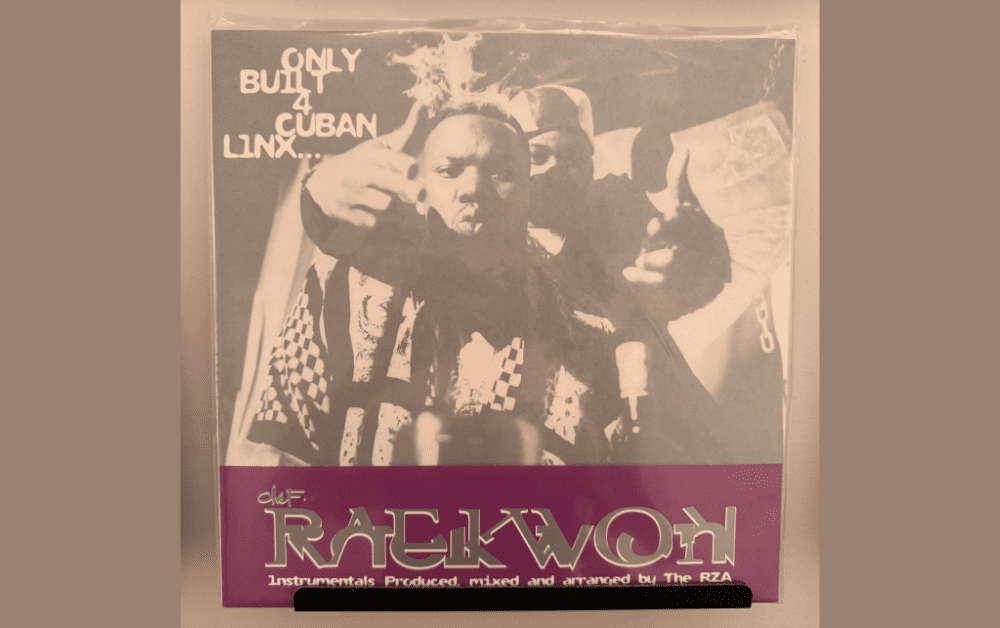
Raekwon’s Only Built for Cuban Linx… (the instrumental version) – Photo by Talmage Garn
- “Criminology” twists Black Ivory’s “I Keep Asking You Questions” into jagged stabs, turning a smooth soul groove into a knife fight.
- “Rainy Dayz” takes Barbra Streisand’s “No More Tears,” slows it, and re-pitches it until romance decays into pure melancholy.
- “Ice Cream” flips Rufus Thomas’ “The Breakdown (Part II)” and Earl Klugh’s “A Time For Love” into a silk-laced street corner love song, tension-filled.
- “Glaciers of Ice” layers baroque strings into feverish paranoia.
- “Knuckleheadz” chops The Dramatics’ “Get Up & Get Down” into restless fragments, unpredictable and unstable. As well as shots from a .38 revolver, one of the first known instances of gunshots used as percussion (Pyotr Ilyich Tchaikovsky beat him by a few years)
The samples didn’t sit as a backdrop; they advanced the story. RZA also pulled directly from cinema. “Rainy Dayz” opens with Chow Yun-Fat’s weary confession from The Killer:
“You gotta hold it in your heart. I don’t have anybody.”
It plays like foreshadowing in a script. “Shark Niggas (Biters)” is staged as a mob sit-down, more of a scene than a skit. “Wu-Gambinos” ends with the hidden “Lex Diamonds Story,” a narrated epilogue that rolls like film credits.
RZA’s sampling philosophy was montage, not looping. Each fragment served to characterize, convey mood, or advance the plot. The crate and the cinema became a single reality.
Gunshots as Percussion
If samples provided atmosphere, the gunshots supplied action. On “Knuckleheadz,” RZA incorporated .38 revolver blasts sourced from the Sound Ideas General Series 6000 library, the same effects catalog used in numerous films.
He placed them with surgical precision, sharp and close in the mix, where a drummer might add a snare roll. They land every few measures, cutting into the rhythm and startling the listener, less sound effect than percussion instrument. They divide verses into distinct “scenes,” giving the song a start-stop rhythm of chaos.
The choice of weapon mattered. A .38 revolver is small, its sound clipped and intimate. It feels close-range, personal, the kind of violence that happens in hallways and stairwells. That made it perfect for Cuban Linx, an album about survival in close quarters rather than battlefield spectacle. Gunfire had been used in rap before, but it was usually employed as an ornament. Here it was structural, part of the groove itself.
This approach became influential and was later echoed by Mobb Deep, Griselda, and beyond. But in 1995, it was revolutionary: gunshots functioning as drums, rhythm as violence.
Mafioso Rap: Building a Criminal Empire
By the mid-1990s, New York rap was moving from raw reportage to elaborate underworld mythology. Only Built 4 Cuban Linx… became the pivot.
It was built on foundations laid earlier. Kool G Rap had pioneered the imagery of crime bosses on Road to the Riches (1989), establishing mafioso lexicon years before Rae. Scarface, from Houston, deepened the psychological scope of The Diary (1994), mixing street fatalism with introspection. Both prepared the ground, but Rae, Ghost, and RZA transformed it into complete cinematic immersion.
Raekwon’s linguistic innovation created passwords into this universe: “lex diamonds,” “pinky rings,” “beef patties.” Ghostface added volatility, wild imagery, humor, and emotion. RZA staged it all with cinematic sequencing.
The influence was immediate:
- Junior M.A.F.I.A. – Conspiracy (1995): Biggie and Lil’ Kim framed their crew as a mafia family, adopting Rae’s syndicate structure.
- Jay-Z – Reasonable Doubt (1996): The hustler as kingpin, using mafioso imagery to elevate street business into boardroom strategy.
- Nas – It Was Written (1996): Introduced his “Nas Escobar” persona, born on Cuban Linx.
- The Notorious B.I.G. – Life After Death (1997): A sprawling double album that unfolds like a crime saga, marked by betrayal, revenge, and luxury excess.
Later generations extended it: Rick Ross’ Port of Miami (2006) introduced mafioso rap into Southern trap, while Clipse, Westside Gunn, and Griselda (of the 2010s) revived it with Buffalo grit, fashion references, and cover art reminiscent of crime cinema posters.
Mafioso rap evolved into more than just a subgenre. It was proof that hip-hop albums could function like serialized crime fiction, with recurring characters, codes of honor, and coherent mythology.
The Story in Three Acts
Like a film, Only Built 4 Cuban Linx… unfolds in acts.
Act I: The Set-Up and First Blood
- “Striving for Perfection”: Opening credits, Rae and Ghost plot their rise.
- “Knuckleheadz”: The first firefight, U-God’s “death” echoes his incarceration.
- “Criminology”: Mid-operation tension, jagged soul chopped into sparks.
Act II: Pressure and Betrayal
- “Incarcerated Scarfaces”: Power projected from prison, wealth, and aura intact.
- “Rainy Dayz”: Emotional interlude, lovers waiting while hustlers grind.
- “Guillotine (Swordz)”: A cipher staged as a sword fight, lyrical combat as martial arts.
- “Shark Niggas (Biters)”: Mafia sit-down, warning imitators.
Act III: The Climax and the Crown
- “Glaciers of Ice”: Paranoia swelling, Wallabees as status symbols.
- “Verbal Intercourse”: Nas enters as royalty, outside validation in the middle of chaos.
- “Ice Cream”: The romance scene, women as flavors, comic relief.
- “Wu-Gambinos”: Finale posse cut, aliases revealed, “Lex Diamonds Story” as credits.
The sequencing mirrors a gangster epic.
Critical and Commercial Impact
When the purple tape dropped, it debuted at #4 on the Billboard Hot 100 and #2 on the R&B/Hip-Hop chart, selling 130,000 copies in its first week. It was certified Gold by October 1995, and Platinum decades later. But numbers tell only part of the story.
The real impact was cultural. The Source gave the album five mics, solidifying it as a classic. Fans weren’t just buying a record; they were buying into mythology. The cassette itself, molded in purple plastic, became a relic, shorthand for mafioso rap itself.
Cuban Linx’s Legacy
Nearly three decades later, Only Built 4 Cuban Linx… is one of the few albums known more by its cassette’s color than its title. The purple tape glows in memory as much as the music itself.
The lineage is clear:
- Kool G Rap and Scarface built the blueprint.
- Raekwon, Ghostface, and RZA perfected it for the big screen.
- Junior M.A.F.I.A., Jay-Z, Nas, and Biggie expanded it into dominance.
- Rick Ross carried it South.
- Westside Gunn and Griselda resurrected it for modern underground prestige.
- Clipse turned it into Coke Rap
Mafioso rap has endured for more than three decades because it addresses timeless themes of ambition, loyalty, betrayal, and survival, conveyed through coded slang and luxurious detail.
Raekwon revisited the saga in 2009 with Only Built 4 Cuban Linx II. It was darker and reflective, like a sequel to a classic film. But the original remains untouchable, a cultural lightning strike.
The legacy of Only Built 4 Cuban Linx… rests on three pillars: Raekwon’s lexicon, Ghostface’s volatility, and RZA’s production as cinematic sequencing. Together, they changed not just how rap albums sounded but also how rap albums could function.
For more Wu-Tang and other hip-hop features