


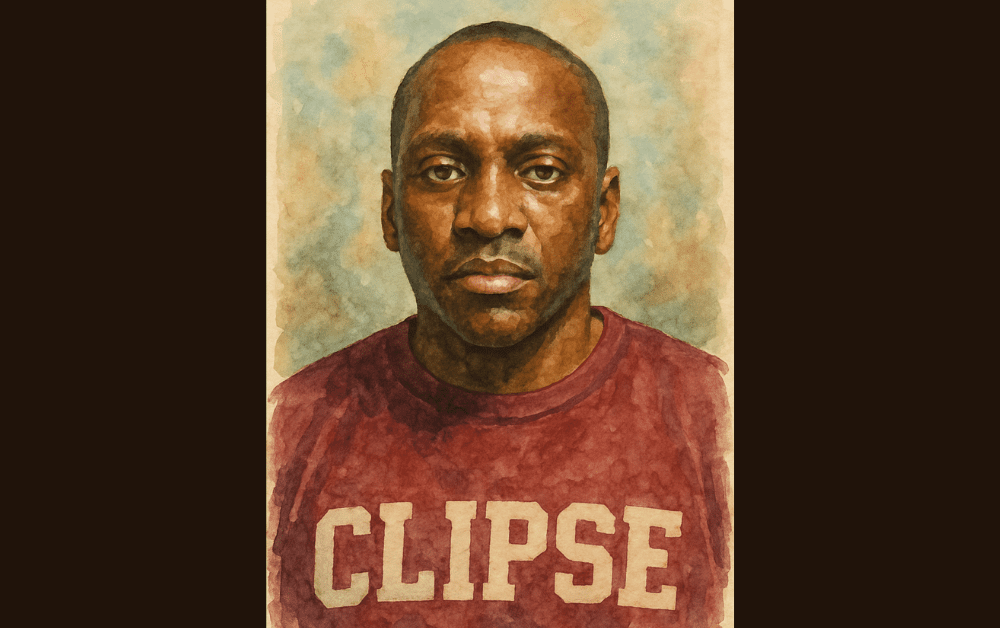
Where No Malice Went: How Gene Thornton’s Faith Journey Led to a Clipse Reunion
Hip-hop has always contended with the tension between street realities and spiritual consciousness. Still, few artists have embodied this struggle as visibly as Gene Thornton, formerly known as Malice, now as No Malice. After over a decade of laying low, No Malice is back, joining his brother, Pusha T, as the legendary duo Clipse. But what sparked his departure, and why has he chosen to return now?
Clipse’s Early Impact: Grinding to Greatness
Formed by brothers Gene “Malice” Thornton and Terrence “Pusha T” Thornton in Virginia Beach, Clipse made their name in 2002 with their debut album Lord Willin’. Powered by the Neptunes-produced hit “Grindin’,” the duo quickly became major players in hip-hop. Their gritty, street-driven lyricism paired with The Neptunes’ most avant-garde beats placed them in rap’s spotlight.
RELATED: Explore Clipse’s unreleased album
They solidified their status with 2006’s critically acclaimed Hell Hath No Fury, considered one of the defining albums of the decade for its uncompromising authenticity. Their third album, Til the Casket Drops (2009), marked a shift away from The Neptunes and toward Kanye West.
Yet at the peak of their influence, internal struggles and the arrest of their manager, Anthony Gonzales, who was sentenced to over 30 years for drug trafficking, forced a turning point for Malice.
From Malice to No Malice: A Spiritual Reckoning
In March 2012, Gene Thornton officially shed his former identity by tweeting: “R.I.P. ‘Malice’ 8/20/2002 – 3/6/2012.” The tweet drew a line in the sand. The arrest of Gonzales affected Thornton, who didn’t want to glorify the very lifestyle that destroyed lives around him.
In a 2016 interview discussing his documentary The End of Malice, he reflected:
“For a moment it seemed fun, but in 2009 it was the devil, and he was coming for his stuff back.”
This epiphany prompted Thornton to abandon his Malice persona entirely. He emerged as No Malice, rejecting his former rap and cocaine kingpin facade (or lifestyle?).
A Purposeful Pause: No Malice’s Solo Journey
No Malice’s solo period showed purposeful introspection. He chose ministry over mainstream success. In 2011, he released the memoir Wretched, Pitiful, Poor, Blind & Naked, a raw account of his transformation. No Malice then released his debut solo album, Hear Ye Him (2013), in which he fully embraced Christian themes and personal redemption.
No Malice continued his ministry through music with 2017’s Let the Dead Bury the Dead, which focused on confronting inner demons, addressing social ills, and providing a hopeful alternative narrative to street life. In a candid interview with DJBooth, he explained:
“I’m still the same rapper, but I just have different stories to tell now.”
His career now revolved around mentoring youth, speaking in prisons, and advocating for spiritual growth over fame.
Why Clipse’s Reunion Matters Now
The timing of Clipse’s reunion is significant not only because of personal readiness but also because of cultural readiness. Hip-hop has increasingly embraced storytelling that challenges traditional narratives, welcoming more vulnerability and reflection over the glorification of success. The duo’s reunion aligns perfectly with this evolution.

Clipse’s Comeback Trajectory Line Chart, plotting Clipse’s and No Malice’s projects by: Metacritic Score (critical acclaim on the Y-axis), Year of release (X-axis), Thematic Shift labeled below each point (Street → Introspective → Spiritual) | Credit: Talmage Garn
No Malice’s decision to reunite was deeply personal. His father, a respected church deacon, gave his blessing and provided critical clarity. As No Malice shared with Rapzilla:
“Boy, you owe it to the world. Let your mess become your message.”
Further momentum for the reunion came through primary industry backing from Roc Nation and renewed collaboration with long-time producer Pharrell Williams. Clipse’s return comes at a time when hip-hop increasingly rewards substance, depth, and authenticity.
The duo’s reunion single “Ace Trumpets” exemplifies this balance. Pitchfork praised No Malice’s lyricism:
“He raps ‘Never leaving home without my piece like I’m Mahatma,’ with his trademark steely gaze.”
This fusion of spiritual maturity and lyrical dexterity highlights No Malice’s journey back into hip-hop, now armed with purpose rather than mere bravado.
Timeline of No Malice’s Transformation
- 2009: Manager’s arrest triggers spiritual reckoning
- 2011: Releases memoir Wretched, Pitiful…
- 2012: Retires “Malice,” becomes No Malice
- 2013: Releases Hear Ye Him
- 2016: Documentary The End of Malice premieres
- 2019: Appears on Kanye West’s “Use This Gospel“
- 2025: Announces Clipse reunion album Let God Sort ‘Em Out

Timeline of No Malice’s transformation | Credit: Talmage Garn
No Malice: Lyrical Evolution
- Clipse (Malice): “Disguise it as art so the feds back up.” — Street life, bravado
- No Malice: “Twenty-one-gun salute, we been savage.” (“So Be It“) — Street-wise, reflective
- Clipse Reunion: “Never leaving home without my piece like I’m Mahatma.” (“Ace Trumpets”) — Spiritual, purposeful

No Malice’s lyrical evolution | Talmage Garn
How Many Rappers Go Religious?
- Early spiritual references include 2Pac, Bone Thugs-N-Harmony, and Nas.
- Notable career shifts: Mase (Pastor Mason Betha), MC Hammer (ordained minister).
- Modern spiritual artists include Chance the Rapper, Kanye West, Lecrae, and NF.
- No Malice’s uniqueness: Completely exited mainstream rap to pursue faith-based content before returning on spiritual terms.
When God and Grindin’ Collide
Clipse’s reunion, guided by No Malice’s evolution, transcends mere nostalgia. It represents redemption, responsibility, and the powerful idea that personal transformation can resonate deeply with the world. No Malice’s return turns his “mess into a message, reminding audiences that hip-hop can meaningfully engage with life’s complexities and inspire change.
Want to revisit some classic Clipse songs? Or explore their origin story through label struggles and spiritual pivots? Please don’t sleep on We Got It 4 Cheap, either.
Also, check out our curated list of Pusha T’s best solo tracks and explore the roots of Coke rap’s lyrical legacy.
This reunion marks not just the return of a beloved rap duo but the renewal of an artist committed to authenticity, driven by spiritual clarity and a renewed purpose.